
WMLW The M - Milwaukee

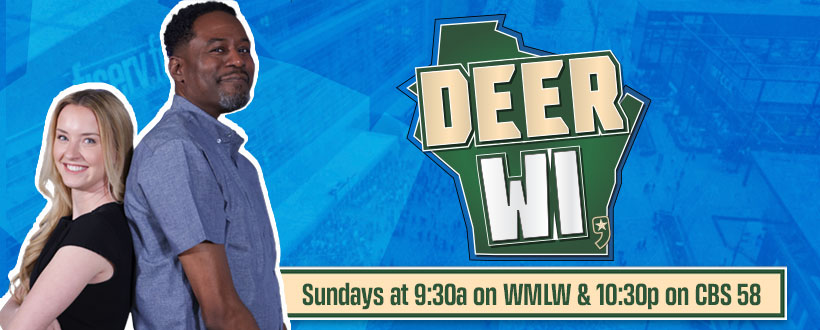
"Deer Wisconsin" is a fun, fresh 30-minute lifestyle show centered around the food, fun, entertainment and people making Milwaukee's Deer District an amazing place.
Hosted by Nicole Sedivy and Anthony Foster, "Deer Wisconsin" airs Sunday mornings at 9:30 on WMLW The M. It also airs Sunday nights at 10:30 on CBS 58."
Tips for antenna viewers:
Order your collectible retro-t-shirt:
WMLW The M released a collectible retro-style t-shirt to mark the return of the Milwaukee Bucks to free over-the-air television this season. Order yours while supplies last!

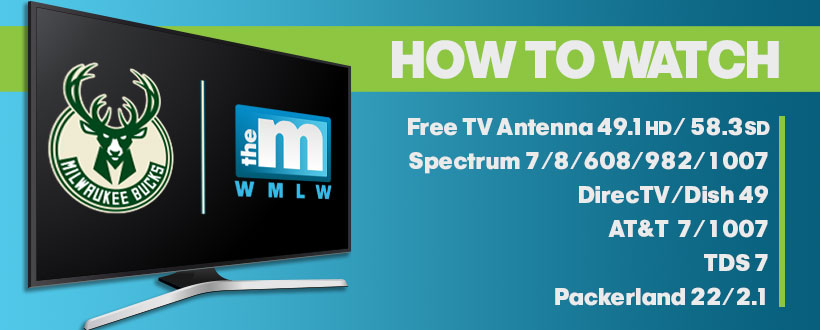
Where to Watch
- Free TV Antenna 49.1 / 58.3
- Spectrum 7/8/608/982/1007
- DirecTV / Dish 49
- AT&T 7/1007
- TDS 7
- Packerland 22/2.1
The Neighborhood
Welcome to the Hockey Game
"After Calvin actually enjoys attending a hockey game with Dave, Malcolm and Marty wonder if their neighbor is rubbing off too much on their dad. Also, Tina decides to enjoy the perks that come with her "stardom" when she's mistaken for an A-list celebrity during a girls' trip with Gemma."The Neighborhood
Welcome to Thanksgiving
"Dave and Gemma host a memorable Thanksgiving in their new home when Dave's politically incorrect mother, Paula, visits from out of town and meets Calvin, Tina, and the rest of the Butler family for the first time."Young Sheldon
A Broken Heart and a Crock Monster
"The coopers help pastor jeff through a rough patch in his marriage. Also, sheldon pressures church members for donations when mary takes him to work for a day."Big Bang Theory
The Misinterpretation Agitation
"A doctor misconstrues Penny's workplace flirting and falls for her. When Dr. Lorvis turns up at her apartment, it's the guys who find themselves interested in him and his impressive memorabilia collection. Meanwhile, Bernadette is going to be featured in an article about hot female scientists, but Amy disapproves of the article and its sexualisation of women."Big Bang Theory
The Large Hadron Collision
"Leonard faces a dilemma in choosing between Sheldon or Penny to accompany him to Switzerland to see CERN's Large Hadron Collider on Valentine's Day."Chicago P.D.
Fagin
"When the team is called to an in-progress bank robbery, they come across a Robbery-Homicide detective trying to take over the crime scene; and, as the robberies continue, Lindsay makes a decision that unveils a surprising suspect behind the mask. While working on the case at the district, Upton is shocked to come across Platt, who has a special connection to her past."Law & Order: Special Victims Unit
Witness
"Soon after a young girl, laine mcalister (guest star diora baird), is raped in her apartment building's stairwell, detectives olivia benson (mariska hargitay) and eliot stabler (christopher meloni) meet laine in the hospital and find her extremely shaken with a large cut on her hand. After an unpleasant exchange with a man she claims is her boyfriend, the detectives become suspicious that she may have fabricated her rape to get attention. Their suspicions grow when she waits to reveal that therLaw & Order: Special Victims Unit
Witness
"Soon after a young girl, laine mcalister (guest star diora baird), is raped in her apartment building's stairwell, detectives olivia benson (mariska hargitay) and eliot stabler (christopher meloni) meet laine in the hospital and find her extremely shaken with a large cut on her hand. After an unpleasant exchange with a man she claims is her boyfriend, the detectives become suspicious that she may have fabricated her rape to get attention. Their suspicions grow when she waits to reveal that therMom
Freckled Bananas and a Little Schwinn
"Christy and Bonnie resume illegal activities, leading Adam to question their morality."Closed Captioning Concerns
For closed captioning specific questions, please contact Steve Percefull at [email protected] or:Call: (414)607-8162Or Fax: (414) 777-5802
Mailed comments can go to our regular mailing address, but should be marked:"ATTENTION: CLOSED CAPTIONING COMMENTS" 809 S. 60th Street Milwaukee, WI 53214
WMLW: FCC Public File - FCC License Renewal - EEO Report - Children's Programming List
WBME: FCC Public File - FCC License Renewal - EEO Report - Children's Programming List